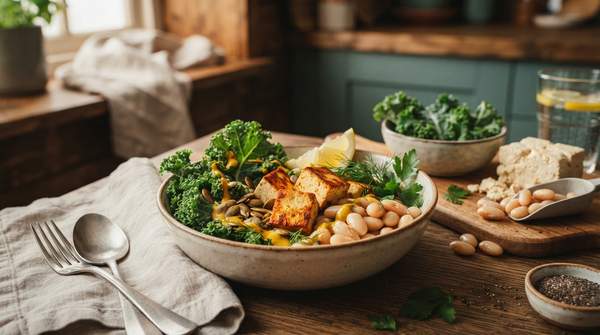
Here's the snack-aisle secret most calcium lists skip: the milligram count on the label is only half the story. A review of foods for plant-based diets puts it bluntly—more important than how much calcium you consume is how much you actually absorb, and phytates and oxalates in plant foods are the main things standing in your way. The good news? Snacks like calcium-set tofu, kale, and almonds deliver far more usable calcium than their flashier, higher-milligram competitors. This guide compares five accessible options on both dimensions, so you can snack for your bones with confidence.
Beyond the Label: Why Bioavailability Matters for Plant-Based Calcium
Bioavailability is simply the fraction of a nutrient in a food that your body can actually absorb and put to work. It's why a cup of cooked spinach, despite packing 243 mg of calcium, delivers less usable calcium to your bones than a modest handful of almonds with just 80 mg on paper. A nutritionist-compiled bioavailability table by Tania Gelmetti, hosted by the European Society of Endocrinology, makes the arithmetic visible: spinach's calcium is only about 5% absorbed, yielding roughly 12 mg, while almonds at 21% absorption yield about 17 mg from a smaller starting amount.
That same review of plant-based diets recommends choosing foods rich in calcium and high in bioavailability, noting that absorption also depends on physiology—age, pregnancy, and lactation all shift the equation. So when you're comparing snacks, the question isn't just "how many milligrams?" but "how many of those milligrams make it into my bloodstream?"
The Calcium Blockers: Oxalates and Phytates
Two compounds do most of the blocking. Oxalates bind calcium into insoluble crystals that pass through you unabsorbed—spinach and rhubarb are the notorious examples, which is why The Vegan Society rates both as "poor" sources despite their impressive calcium totals. Phytates, found in seeds, legumes, and whole grains, are the other big inhibitor. Dietitians Australia notes that phytates limit calcium absorption, and because vegetarian and vegan diets are naturally high in plant foods, phytate exposure can mean higher calcium needs overall.
The flip side is that some plant foods carry very few of these inhibitors, or process them away. That's the whole game: low-oxalate greens like kale, broccoli, and bok choy sit in the "good" absorbability column, while calcium-set tofu gets its calcium added directly during processing, sidestepping the inhibitor problem almost entirely.