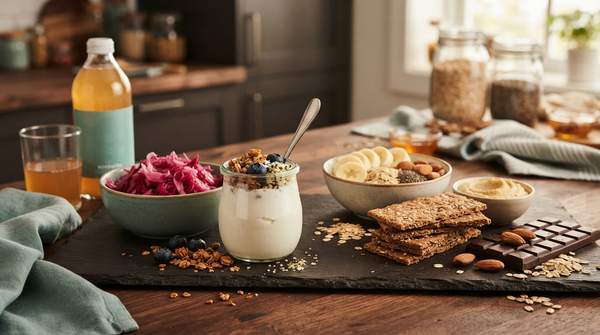
A snack promising a "happier gut" is not the same as a snack containing ingredients proven to feed your gut bacteria. The difference comes down to the label: a genuinely functional product names a scientifically recognized prebiotic—like inulin, fructo-oligosaccharides (FOS), or galacto-oligosaccharides (GOS)—and provides enough of it. The International Scientific Association for Probiotics and Prebiotics (ISAPP), the nonprofit that established the currently held definition of prebiotics, considers a daily dose of 5–8 grams of FOS or GOS sufficient to produce a dietary prebiotic effect in adults. A vague fiber claim, by contrast, tells you almost nothing.
Understanding Gut Health: Prebiotics, Probiotics, and Fiber
Three terms get tangled together on food packaging, but they describe fundamentally different things. Prebiotics are, in ISAPP's definition, "a substrate that is selectively utilized by host microorganisms conferring a health benefit"—in plain terms, food components your body cannot digest but that selectively nourish beneficial resident microbes. Probiotics are living microorganisms, most often bacteria or yeast, that help the body digest food or ease symptoms of certain conditions, as Mayo Clinic staff explain. General dietary fiber is the broadest category: parts of food the body doesn't digest, which may or may not be used by microorganisms.
The selective part is what separates a prebiotic from ordinary fiber. All prebiotics are fibers, but only a specific subset acts as targeted fuel for beneficial gut bacteria like bifidobacteria and lactobacilli. That distinction is exactly what snack marketing tends to blur.
The Science of Prebiotics: Fueling Your Gut Microbiota
The prebiotic concept dates to 1995, when Glenn Gibson and Marcel Roberfroid described it as a non-digestible food ingredient that "beneficially affects the host by selectively stimulating the growth and/or activity of one or a limited number of bacteria in the colon," according to a peer-reviewed review of prebiotic science. When these compounds reach the colon, they are fermented by gut microbiota, a process associated with the production of beneficial compounds such as short-chain fatty acids.
On an ingredient list, the names to know are inulin, FOS, oligofructose, GOS, and TOS (trans-GOS). Inulin is itself a type of FOS, and ISAPP's consumer guidance notes that FOS and GOS are the most widely accepted prebiotics, with the most tested gut prebiotics directed toward bifidobacteria. These compounds occur naturally in foods like chicory root, garlic, onions, and bananas, and ISAPP notes they also count toward total dietary fiber intake—the Institute of Medicine recommends 19 to 38 grams of total fiber daily depending on age and gender, while ISAPP recommends about 5 grams per day of prebiotics specifically.