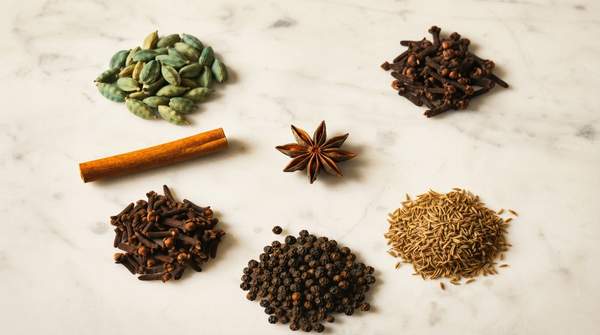
The "mysterious" depth of a blend like Ras el Hanout isn't mysticism — it's chemistry applied with intent. According to the Park City Culinary Institute's writing on flavor science, each spice contains unique compounds that interact to create complex flavor profiles, and by understanding these molecular interactions you can predict how spices will work together, "whether you're aiming for harmony or contrast." Two models do most of the explanatory work: congruent versus complementary pairings, and the base-contrast-bridge method. Once you grasp them, a fifty-ingredient Moroccan blend stops being folklore and starts being engineering.
The Science of Spice Blending: Beyond Intuition
When I first started dissecting traditional blends, I expected to find chaos — cooks throwing pinches of things at a mortar and hoping. What I found instead was structure. The culinary institute's account frames spice blending as a matter of understanding "the science behind taste and aroma," where the goal is prediction rather than guesswork: master the interactions and you can anticipate how two spices will behave together before they ever touch a pan.
That framing matters for traditional international snacks and dishes alike. Debashish Das, writing for the New Zealand spice seller Premium Spices, puts the same idea more bluntly: "Flavor isn't magic. It's the result of chemical compounds interacting in predictable ways." In his telling, your spice rack is "a chemistry lab" and every pinch "an experiment." Neither source claims blenders memorize compound names — but both argue the results follow rules. The practical upshot is that complexity and balance, the two qualities we prize in blends like Garam Masala or Ras el Hanout, are achievable deliberately rather than accidentally.
Congruent vs. Complementary Flavor Pairings
The first pairing principle splits into two moves. Congruent pairings combine spices that share similar flavor characteristics, producing a unified profile where the components "naturally align." The culinary institute's example is cinnamon, nutmeg, and allspice together — a smooth, cohesive taste in which no single note pulls against the others. This is the tool you reach for when you want the spice to "complement rather than compete with the main ingredient."
Complementary pairings take the opposite route: deliberately introducing contrasting flavors "to add complexity and intrigue the palate." Where congruence reinforces a single impression, contrast builds depth — the layered, dynamic effect that makes a blend feel alive rather than one-note. Both models can appear in the same blend, which is exactly what a complex traditional mixture does: a harmonious core of similar warm notes, punctuated by contrasting accents that keep the palate curious.
The Base-Contrast-Bridge Model for Layered Flavors
The second model is architectural. In the method Das describes for Premium Spices, a blend is built in three roles. A base spice forms the foundation — his worked example uses cumin for a warm, earthy floor. A contrast spice then cuts against that foundation: "We add smoked paprika for a sweet, smoky note that cuts through the earthiness."
Then comes the part that separates a real blend from a pile of spices: the bridge. "A pinch of cardamom ties the citrus brightness of coriander to the sweetness of paprika, making the blend feel complete," Das writes. The bridge is the unifying element that makes base and contrast feel designed together rather than merely adjacent. He completes his example rub with cumin, coriander, smoked paprika, cardamom, and salt to taste — suited to chicken, vegetables, or roasted chickpeas. Crucially, he claims the method generalizes: "once you understand this method, you can design blends for any cuisine, Moroccan ras el hanout, Indian garam masala, and Mexican adobo without relying on a recipe."
Ras el Hanout: A Masterclass in Blending Science
Ras el Hanout makes the ideal test case because its complexity is famous but its composition is famously loose. PepperScale's overview of the blend notes that many cooks skip the ultra-obscure ingredients and build from common spices like cumin, coriander, and cardamom — often yielding something closer to curry powder or garam masala in flavor. But the target, when the blend is "carefully assembled," is specific: a result "layered with multiple complementary flavor and aroma notes."
Notice that "complementary" is doing real work in that sentence. The layering PepperScale describes is the complementary-pairing principle in action — many distinct flavor and aroma notes coexisting without one erasing the others. Even the heat question is structural: the blend "can be spicy but does not have to be," with black pepper in most blends and cayenne or long pepper optional. Spiciness is a dial, not an identity.
Taste of Maroc's Nada Kiffa, describing a Fez-style variation, compares Ras el Hanout to garam masala and curry powder as a versatile mix of warm, fragrant spices — then insists the comparison stops there, because the three have distinctly different flavor profiles. Ras el Hanout is its own architecture, not an exoticized curry.
Deconstructing Spice Blends: A Scientific Framework
Here is the analytical toolkit in one place — the two models, their roles, and worked examples from the evidence. Use it in reverse: given any blend, ask which spice is the base, which provides contrast, which bridges, and whether a given pairing is congruent or complementary.
| Blending Principle | Role in Flavor Profile | Example Application |
|---|---|---|
| Congruent pairing — spices share similar flavor characteristics | Unified, smooth, cohesive taste; components "naturally align" without competing | Cinnamon, nutmeg, and allspice combined into one harmonious warm note |
| Complementary pairing — contrasting flavors introduced deliberately | Complexity, depth, and a layered, dynamic profile that intrigues the palate | Ras el Hanout's "multiple complementary flavor and aroma notes" when carefully assembled |
| Base spice — foundational flavor | The warm, earthy floor the rest of the blend stands on | Cumin as the base of a rub that works on chicken, vegetables, or roasted chickpeas |
| Contrast spice — cuts against the base | A distinct note that prevents monotony and adds intrigue | Smoked paprika adding a sweet, smoky note that cuts through cumin's earthiness |
| Bridge spice — ties base and contrast together | Makes the blend feel complete and intentional rather than accidental | Cardamom linking coriander's citrus brightness to paprika's sweetness |
What the framework reveals is that complex blends are not arbitrary. Every ingredient earns its slot by occupying a defined role — reinforcing, opposing, or unifying — and the same analysis applies from a Moroccan tagine rub to garam masala. The one honest caveat: the sources I drew on describe these interactions at the level of flavor roles and pairing logic, not named aromatic compounds, so don't expect this framework to hand you molecular formulas. It hands you something more useful at the stove — a working grammar of flavor.
Mastering Flavor: From Mystery to Predictable Chemistry
So was the traditional blender thinking in these exact terms? Probably not — the sources describe the practice, not the vocabulary. But Taste of Maroc's description of the craft, where Ras el Hanout demands "a steady hand and a good knowledge of the spices and aromas," reads like the base-contrast-bridge model wearing a mortar and pestle. Skill, in this light, is applied intuition about exactly these interactions.
Readers can apply the congruent/complementary and base-contrast-bridge models to understand the intentional design of complex blends like Ras el Hanout — and to guide their own culinary experimentation. The measurable test: the next time you open a blend, identify and articulate its base, contrast, and bridge components, plus its congruent and complementary pairings, before tasting. If you can name cumin's earthy foundation, a smoky or floral contrast, and the spice knitting them together, you've crossed from mystery to method — and your own experiments start from design rather than chance.