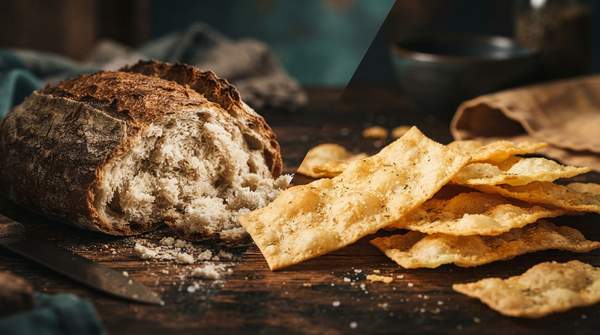
That firm, dry slice of bread in your breadbox and that satisfyingly snappy cracker in your pantry are both shaped by the same molecular process. It is called starch retrogradation: after heat and water swell starch molecules during baking, cooling lets those molecules reassociate and drift back toward a rigid, crystalline structure. In soft, high-moisture foods like pan bread, tortillas, and steamed buns, this re-crystallization is the primary driver of staling, according to food scientist Lena Bosc-Bierne, writing for KPM Analytics. In dry products like crackers and biscuits, the very same firming dynamic reinforces structure and helps maintain crispness over time.
What Is Starch Retrogradation?
Think of retrogradation as gelatinization in reverse. During baking, starch granules absorb water, swell, and their molecules spread apart into a soft, pliable gel. Once the product cools and goes into storage, the two main starch components—amylose, the linear chains, and amylopectin, the branched chains—begin to realign and edge back toward a crystalline arrangement. The result is a progressively more rigid, gel-like structure.
This is not a one-time event. As KPM Analytics' technical explainer on wheat starch describes it, retrogradation is a natural aging process: during storage, starch molecules keep bonding, increasing firmness and squeezing out water, a phenomenon known as syneresis. That expelled water is why stale bread feels not just hard but also dry and crumbly, and why noodles left in the fridge turn rubbery.
The Dual Nature of Retrogradation: Staling vs. Crispness
The apparent paradox—retrogradation ruins bread but helps crackers—comes down to moisture. In a soft, high-moisture crumb, firmness and water loss are exactly what you do not want; the crumb loses its tender, springy quality. In a dry product that is already hard, there is little softness to lose, so the same molecular tightening works in the product's favor, locking in a brittle, crisp texture rather than degrading it. Bosc-Bierne is explicit on this distinction: for dry products that are already hard, retrogradation is less of a concern and can even be desirable for maintaining crispness.
Starch Retrogradation: Staling vs. Crispness
The table below compares the two pathways side by side, so you can see how one process produces opposite outcomes depending on the food's starting moisture.
| Stage or Factor | High-Moisture Foods (e.g., Pan Bread, Tortillas) | Low-Moisture Foods (e.g., Crackers, Biscuits) |
|---|---|---|
| Gelatinization (initial baking) | Starch molecules expand and spread, absorbing water into a soft crumb | Starch gelatinizes with limited water, producing a hard, dry structure |
| Retrogradation (cooling and storage) | Amylose and amylopectin realign and crystallize; molecules keep bonding | The same realignment and crystallization occurs |
| Resulting texture change | Crumb firms, softness is lost, and water is expelled (syneresis)—experienced as staling | Firming reinforces the already-rigid structure, helping maintain crispness |
| Desirability for the eater | Undesirable: changes texture and mouthfeel, shortens shelf life | Desirable: crispness is preserved over time |
| Mitigation or reversal | Reheating can temporarily reverse firming; storage temperature affects the rate | Little mitigation needed; retrogradation works in the product's favor |
The takeaway from the comparison: retrogradation is not "good" or "bad" in itself. It is a firming process, and whether firming helps or hurts depends entirely on whether the food started out soft and moist or dry and hard.
Practical Strategies for Home Cooks
Because retrogradation is driven by temperature and time, home cooks have two main levers: how they store starchy foods and how they reheat them. Cooling after cooking is the crucial step during which starch retrogrades and partially restores its crystallinity, as a scientific review of resistant starch published in the National Library of Medicine's journal archive explains. That means the choices you make in the first hours after baking or boiling—how quickly you cool something, and at what temperature you hold it—set the course for its texture in the days that follow.
Reheating: A Temporary Reversal
Here is the good news for anyone staring at a loaf gone leathery: reheating can temporarily reverse retrogradation. Warm the starch back up and the crystals loosen, restoring softness to bread and returning a softer texture to pasta, rice, and potatoes. The catch, as the KPM Analytics material notes, is that the effect is temporary—once the food cools again, the molecules resume their drift back toward a rigid structure, and staling picks up where it left off.
There is also a deliberate way to use this cycle. Clemson University's Home & Garden Information Center describes a cook-cool-reheat approach for rice, pasta, and potatoes: cook the food, let it cool so the starch retrogrades, then reheat and eat it the next day. The cooling step changes how the starch behaves, and the food can then be reheated and consumed the day after cooking. (This method is discussed by Clemson in the context of blood-sugar management; the health implications of retrograded starch are beyond this article's scope, but the texture mechanics are the same.)
Optimal Storage for Freshness
Storage temperature changes how quickly retrogradation proceeds. In one study cited by the resistant-starch review, freshly baked bread was held for seven days at ambient temperature (20°C), frozen (−17°C), or refrigerated (3.5°C), and the refrigerated loaf showed significantly more retrograded starch than the other two conditions. In other words, the fridge is not necessarily bread's friend: refrigeration can accelerate the very recrystallization that makes bread stale, while freezing slows the process down.
For practical purposes, that points to a simple rule for soft baked goods: eat fresh bread at room temperature within a day or two, and freeze what you cannot finish rather than refrigerating it. For dry goods like crackers, the opposite logic applies—keep them dry and let retrogradation work for you.
Keep Your Bakes Fresh: Actionable Tips
To minimize staling and maintain desired textures in homemade starchy foods, home cooks should strategically use reheating and appropriate storage methods. Concretely: freeze rather than refrigerate bread you want to keep soft, reheat stale or cooled starchy foods to temporarily restore softness before serving, and use the cook-cool-reheat cycle deliberately when a firmer texture suits the dish.
The measurable indicator of success is a reduced rate of staling in stored bread and restored softness in reheated pasta or potatoes. If your day-old loaf still softens properly after a brief warming, and your reheated noodles lose their rubbery bite, retrogradation is being managed—not mystified.
Sources
- Starch Retrogradation: How Cooling Changes Everything in Baked Products — Kpmanalytics
- CDN
- Harnessing the power of resistant starch: a narrative review of its health impact and processing challenges - PMC
- Starch Retrogradation: A Method for Post-Mealtime Blood Sugar Management in Individuals with Diabetes — Home & Garden Information Center