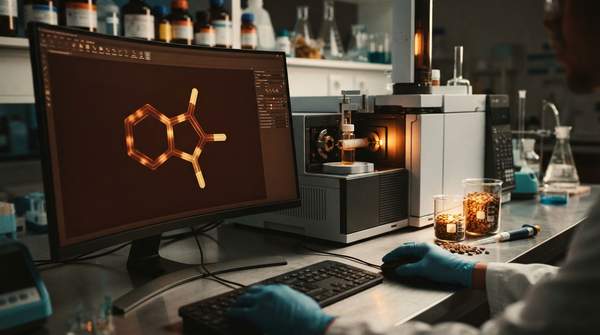
When food scientists wanted to know exactly how the aroma compound 3-methylindole forms during cooking, they did not guess — they built a pipeline. A study published in Food Chemistry: X combined two computational modeling techniques with laboratory validation to trace, molecule by molecule, how the amino acid tryptophan becomes 3-methylindole during the glucose-mediated Maillard reaction. The result is a transferable research framework for understanding how volatile flavor compounds arise in complex food systems — and it works very differently from the AI models that predict what a molecule will taste like.
Introduction: Unpacking Flavor Formation
The Maillard reaction — the chemistry that browns your toast and sears your steak — is a sprawling network of transformations rather than a single event. That sprawl is precisely the problem. Pinning down which branch of the network produces a specific aroma molecule, under real heating conditions, is like reconstructing one particular route through a city you have never mapped. Reporting on the Food Chemistry: X study explains why the answer matters: 3-methylindole is a key aroma compound in fermented sauces, dairy products, and alcoholic beverages, and indole compounds show concentration-dependent sensory behavior, so controlling thermal processing parameters becomes a practical goal for flavor engineering. The challenge was not detecting the compound, but proving how it forms.
The Multi-Stage Scientific Workflow
The study's central insight is methodological: no single tool can do this job alone. Each instrument answers a different question, and the questions must be asked in a certain order. First, a simulation generates the long list of chemical routes that are chemically plausible. Then, more precise calculations rank those routes by energy. Finally, experiments check whether the predicted intermediates actually appear. The researchers combined ReaxFF MD for dynamic pathway mapping, DFT for energy barrier quantification, and experimental techniques including GC-O-MS and Py-GC/MS for validation — a division of labor that turned a vague "cooking makes flavors" into a coherent microscopic picture with a thermodynamic basis.
The Integrated Workflow for Flavor Pathway Discovery
Here is the full sequence, with each stage's distinct contribution and its qualification, as reported for the Food Chemistry: X study. Read it as a relay race: each runner hands a narrower, better-defined question to the next.
| Stage | Technique | What it contributes | Key qualification |
|---|---|---|---|
| 1. Initial exploration | Reactive Force Field Molecular Dynamics (ReaxFF MD) | Simulates dynamic reaction pathways and identifies candidate intermediate compounds — the broad map of possible transformations | Provides an overview of possibilities, not yet a ranked answer |
| 2. Refinement | Density Functional Theory (DFT) | Quantifies the energy barriers of the candidate pathways, indicating which steps are energetically favorable and thus likely | Determines likelihood from thermodynamics; still computational prediction |
| 3. Confirmation | GC-O-MS and Py-GC/MS (pyrolysis-gas chromatography-mass spectrometry) | Experimentally validates the predictions by detecting key intermediates | Py-GC/MS functions as a structural fragment release tool and differs from actual reaction conditions |
| 4. Application | Combined framework | Delivers the validated pathway: a step-by-step mechanism for how 3-methylindole forms from tryptophan | The study focused specifically on the glucose-mediated Maillard reaction |
The logic of the sequence is the article's real lesson: simulation widens the field of suspects, energetics narrows it, and experiments close the case. Skipping a stage would either drown you in unranked possibilities or leave a tidy computational story unconfirmed by the real world.
Step 1: Dynamic Pathway Mapping with ReaxFF MD
Reactive Force Field Molecular Dynamics is the wide-angle lens. By simulating the reaction dynamically, ReaxFF MD lets researchers watch candidate chemical events unfold and identify the intermediate compounds that could plausibly appear along the way. In a reaction as tangled as the Maillard, this matters enormously: the network of possible transformations is too large to enumerate by hand with confidence. The simulation does not declare a winner — it produces the shortlist that the next stage will interrogate, plus the intermediates any eventual answer must account for.
Step 2: Quantifying Energy Barriers with DFT
Density Functional Theory is the precision instrument. Once candidate pathways exist on paper, DFT supplies a more accurate quantification of the energy barriers along each route. A step with a high energy barrier is one the molecules are reluctant to climb; a low-barrier step is energetically favorable and, by that logic, more likely to occur under the cooking conditions in question. This is where the study moved from "here is everything that could happen" to "here is what thermodynamics says probably happens." The pathway the researchers settled on reads like a relay of small, favorable moves rather than one heroic leap.
Step 3: Experimental Validation
Computers propose; experiments dispose. The final stage validated the computational predictions with GC-O-MS and Py-GC/MS, detecting the key intermediates the models had flagged. The confirmed sequence, as the study reports it, runs like this: the Amadori product undergoes 2,3-enolization to yield 1-deoxythreose, which produces methylmalonaldehyde; tryptophan then undergoes Strecker degradation with methylglyoxal to form indole-3-acetaldehyde, which is finally decarbonylated to 3-methylindole. One caveat keeps this honest: Py-GC/MS works as a structural fragment release tool and differs from actual reaction conditions — validation, not replay. Together the stages give both a coherent microscopic image and a thermodynamic basis for flavor formation.
Beyond Taste Prediction: Pathway Elucidation vs. AI Models
This workflow solves a different problem from the AI tools making headlines in food science. A study published in npj Science of Food by Yoel Zimmermann and colleagues describes FART, a Flavor and Aroma Representation Transformer: a chemical language model that predicts the taste of a molecule directly from its structure. As those authors note, determining a single molecule's taste is traditionally time- and labor-intensive, relying on human panelists or electronic tongues, so in-silico prediction could accelerate the discovery of novel tastants. They also suggest machine learning can shortlist flavor-rich small molecules from natural foodstuffs so that only a few promising candidates need experimental validation.
The distinction is the question being asked. FART answers "what will this molecule taste like?" The 3-methylindole work answers "how does this molecule come to exist in my food?" Both are computational, both end in experiments — but one models perception, the other models formation chemistry.
Applying Pathway Knowledge in Food Science
Food scientists can leverage this multi-stage computational and experimental methodology to precisely identify and understand the formation pathways of other critical flavor compounds — the 3-methylindole case is a framework, not a one-off. That means a demonstrable indicator of progress: the publication of new research papers detailing the elucidation of novel flavor compound pathways using similar integrated computational and experimental approaches. For anyone tracking the field, that literature — not a single dramatic breakthrough — is the measurable signal that the method is spreading, one pathway at a time.