Here's the short answer: sumac is a single spice — the dried, ground berry of a plant, all on its own — while za'atar is a blend that typically contains sumac alongside thyme, sesame seeds, and salt. Sumac brings a focused, tangy, lemon-like brightness; za'atar layers that tang with herbal, earthy, nutty notes. They're related, but they are not interchangeable, and knowing which one your recipe wants is the difference between a bright finishing note and a full savory crust.
Understanding Sumac: The Tangy Single Spice
Sumac is a one-ingredient spice made from dried and ground berries, with a deep red color and a tangy, slightly sour taste often compared to lemon — though, as spice sellers at The Spice Way describe it, with softer acidity and a mild fruitiness that makes it gentler than a straight squeeze of citrus. Watany Palestinian Products, a seller of Palestinian goods, adds that the flavor is more balanced and earthy than lemon's sharp hit.
That single-note character is exactly what makes sumac useful. Because it delivers one clean, tart signal, you can deploy it precisely: a dusting where you want brightness, color, and a whisper of fruit. It's a familiar sight in dishes like musakhan, salads, grilled meats, and rice, and it pairs well with roasted vegetables, legumes, and yogurt-based dips.
Exploring Za'atar: A Versatile Herb and Spice Blend
Za'atar is not a single spice but a blend, and that's the heart of the confusion. A traditional version typically includes thyme, sesame seeds, sumac, and salt — a formula echoed by Watany Palestinian Products and by the Institute of Culinary Education, which recounts a Palestinian family recipe of nothing more than wild hillside thyme, sumac, toasted sesame, and salt. Some variations add oregano or other herbs depending on the region.
Commercial blends show how far that variation can stretch. Savory Spice's za'atar, for instance, lists sumac, toasted sesame seeds, salt, cumin, thyme, Greek oregano, and marjoram. Food writer Suzy Karadsheh, who has tested many blends, notes that flavor and texture vary quite a bit: some are more herbaceous, some have a stronger tang from the sumac, and some deliver more crunch from the sesame. One constant, per the Institute of Culinary Education, is sumac itself — the ingredient you can count on in every za'atar worth its salt.
Sumac vs. Za'atar: A Quick Reference Guide
The table below contrasts the two across the four attributes that matter most in practice: what they're made of, how they taste, how they feel, and where they belong on the plate. The core logic is simple — a single spice gives you one focused flavor, while a blend gives you a layered one — and each row follows from that distinction.
| Attribute | Sumac | Za'atar |
|---|---|---|
| Composition | A single spice: dried, ground berries of the sumac plant | A blend: typically thyme, sesame seeds, sumac, and salt; often oregano, marjoram, or cumin |
| Primary flavor notes | Tangy, citrus-like, slightly fruity, with soft acidity and an earthy undertone | Complex: fragrant, herby, tangy, earthy, and nutty, sometimes with peppery notes |
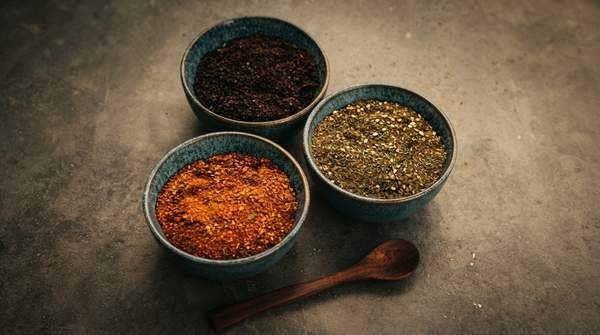
| Texture | A fine, deep-red powder | A coarser mix; varies from herbaceous to crunchy depending on sesame content |
| Common culinary uses | Salads, grilled meats, roasted vegetables, rice, marinades, dressings, yogurt dips | Mixed with olive oil for bread (man'oushe), sprinkled over hummus and labneh, roasted vegetables, chicken, fish, lamb |
Read the composition row first and the rest follows: because sumac is one ingredient, its flavor is focused; because za'atar is several, its flavor is layered and its texture is coarser. That's why the two can't simply swap for each other in a recipe.
Culinary Applications: How to Use Each Spice
Sumac shines as a brightener. Sprinkle it over salads, grilled meats, or roasted vegetables; stir it into marinades and dressings; or finish rice and yogurt-based dips with it. Its vivid red color does visual work too, making it as much a garnish as a seasoning — the sort of spice that lifts a simple salad or seasons kebabs while adding a bold streak of color.
Za'atar is built for bigger jobs. The classic move is mixing it with olive oil into a paste — use more oil for dipping, less for spreading, as Savory Spice suggests — and the most famous application is man'oushe, pita topped with that za'atar-olive oil paste before baking, a popular any-time-of-day snack in the Middle East. Beyond bread, the Institute of Culinary Education recommends it sprinkled over any dip, from labneh to hummus to baba ganoush, or used in marinades for meat and vegetables. It's equally at home on chicken, fish, lamb, eggplant, and roasted carrots, or simply tableside as a finishing seasoning.
Choosing the Right Spice for Your Dish
My rule of thumb: ask what the dish is missing. If it needs a singular jolt of brightness — a tart, citrusy spark on fattoush, grilled chicken, or roasted cauliflower — reach for sumac. If it needs a whole savory landscape — herbs, nuttiness, tang, and salt woven together, whether on flatbread, labneh, or lamb — reach for za'atar. Sumac is the accent; za'atar is the composition.
When buying za'atar, Karadsheh's advice is practical: knowing what's in the jar helps you choose a blend and put it to good use. Check the ingredient list, taste whether it leans herbal, tangy, or crunchy, and note that a greener blend isn't automatically better — different proportions of herbs, sumac, and sesame simply change the color and texture. Look for it in Middle Eastern and Mediterranean grocery stores, specialty spice shops, or a well-stocked supermarket's spice aisle.
One caveat worth keeping in mind: za'atar recipes vary by region and by family, so no single ingredient list is definitive — and this guide doesn't attempt to catalog every regional variation. The blend you buy will have its own balance, which is part of its charm.
Making an Informed Choice in Your Kitchen
To confidently choose between sumac and za'atar, consider whether you need a singular bright, tangy note (sumac) or a complex, earthy, and nutty aromatic blend (za'atar) for your dish. If the recipe calls for a finishing dusting of tartness, the deep-red powder is your answer; if it calls for a crust, a dip, or a paste with herbal depth, you want the blend.
The measurable indicator of success is simple: the reader correctly identifies and uses the right spice for a recipe and achieves the intended flavor profile. Test it the next time you cook — a pinch of sumac should read as bright and lemon-adjacent on the tongue, while a spoonful of za'atar mixed with olive oil should taste herby, nutty, and tangy all at once. If you can predict that difference before the first bite, you've mastered the distinction.
Sources
- What is Sumac Spice? Benefits, Uses, and How to Cook with It — The Spice Way - Nature with Benefits
- Sumac vs Zaatar: Key Differences Explained — Watany Palestinian Products
- Za'atar — Savory Spice
- Za’atar Is the Seasoning I Can’t Live Without—Here’s How I Use It — The Mediterranean Dish
- What is Za’atar Seasoning? — ICE