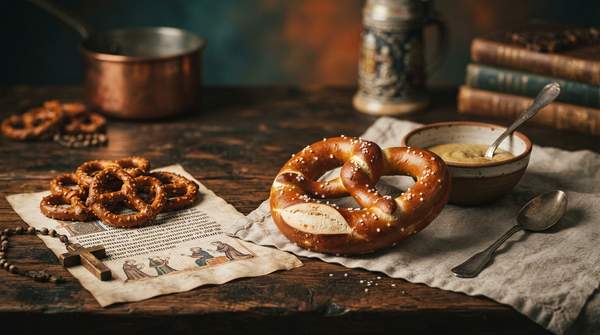
The pretzel began, most accounts agree, as a monastic treat in early medieval Europe—legend places its invention around 610 AD—and ended up as a billion-dollar American snack industry centered on Pennsylvania. Along the way it served as a bakers' guild emblem, a wedding symbol, a Lenten staple, and finally an industrialized food whose soft and hard varieties followed two distinct paths: the soft pretzel remained a European-style fresh bakery good, while the hard pretzel emerged as a distinctly American invention built for shelf life and mass distribution.
The Legendary Origins of the Pretzel in Europe
The most frequently repeated origin story credits an Italian monk around 610 AD, who shaped strips of dough into the form of folded arms in prayer to reward children for learning their prayers during Lent. The pretzel company Tom Sturgis, whose founder Julius Sturgis opened the first American commercial pretzel bakery, likewise traces the snack to southern Europe around that date and notes the shape represents arms crossed over the chest in prayer, with the Latin name "pretiola" said to mean "little rewards."
Food historians treat this charming tale as apocryphal rather than documented fact, and the accounts do not even agree on the monastery's location—some versions place the invention in a French monastery instead. What the legend does capture accurately is the pretzel's deep Christian association: it was a simple food made from flour and water, which fit the Church's restrictions during Lent, and it became a popular staple of the season precisely because it was easy to make and fulfilled those guidelines.
Pretzels in Medieval Europe: Symbolism and Culture
The first solid visual evidence arrives centuries after the legendary invention. A 12th-century manuscript, the Hortus deliciarum, depicts a pretzel at a banquet of Queen Esther and King Ahasuerus, providing the earliest known image of the distinctive twisted shape. By the same century, pretzels appeared in manuscripts and served as emblems for German bakers' guilds, marking them as both culturally and professionally significant.
During the Middle Ages, the pretzel accumulated layers of meaning as a symbol of good luck, prosperity, and spiritual fulfillment. One legend holds that in 1510, bakers working before dawn heard Ottoman forces tunneling beneath Vienna during the siege and raised the alarm, saving the city and earning bakers a coat of arms as reward—though this, like the origin story, is legend rather than verified history. In 17th-century Switzerland, the pretzel entered wedding ceremonies as a symbol of undying love, a practice that some accounts suggest may have inspired the phrase "tying the knot."