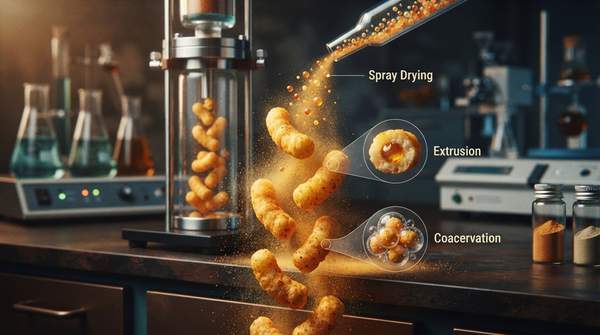
Plant-based snacks taste like plants, and that is the whole problem. Pea, soy, rice, and faba bean proteins carry beany, grassy, earthy, chalky, and bitter notes that food scientists must neutralize before a protein bar or oat yogurt becomes something people actually want to eat. The science of doing that falls into a small toolbox of mechanisms, and the two most important work at completely different levels: one blocks the tongue's taste receptors outright, while the other uses competitive aromas to change what the brain perceives.
The Challenge of Off-Flavors in Plant-Based Proteins
Ask any product developer who works with plant proteins and they will tell you the same thing: plant proteins tend to taste a lot like, well, plants. Glanbia Nutrition, writing for manufacturers, lists pea, soy, rice, chia, and hemp proteins as popular options whose inherent off-flavors run the gamut from beany to green to bitter. Mosaic Flavors, a flavor house, adds chickpea and faba bean to that list and catalogs the descriptors formulators wrestle with: beany, grassy, earthy, chalky, and bitter.
Why do these notes vary so much between suppliers of the same protein? Writing in Food Technology Magazine, Miranda Grizio quotes Rajesh Potineni, vice president of Taste & Innovation R&D at Kerry Taste & Nutrition, who explains that protein type, extraction process (alkaline, enzymatic, or fermentation), and separation techniques such as centrifugation all shape which off-notes appear. Two pea protein isolates can taste dramatically different before a flavorist ever gets involved.
Why Flavor Masking is Essential for Plant-Based Snacks
Not every product needs heavy masking. The intensity of the problem tracks with protein concentration and ingredient complexity. Grizio quotes Potineni noting that products now carry 25 grams of protein per serving, sometimes as high as 40 grams — levels at which off-notes become impossible to simply flavor over.
Glanbia identifies the categories where masking matters most: plant-based dairy alternatives such as beverages, yogurts, and frozen desserts; sports nutrition products including protein bars, powders, and ready-to-drink beverages; and protein-fortified cereals and snacks like crackers, chips, and extruded snacks. Mosaic Flavors similarly describes protein powders, pre-workout mixes, meal replacement powders, stick packs, and gummies as among the most masking-intensive formats because of their high functional ingredient loads. Protein bars combine concentrated plant proteins with fibers and vitamins, compounding the challenge.
An Explanatory Model of Flavor Masking Techniques
The clearest way to understand flavor masking is to sort the techniques by where they act in the sensory pathway. A peer-reviewed review of taste-masking approaches, published in the academic literature on physical approaches to masking bitter taste, lays out three main mechanisms: peripheral interactions where a compound antagonizes a particular taste receptor; central cognitive interactions where one strong taste or aroma reduces perception of the other in the brain; and encapsulation, where the offending compound is physically prevented from reaching taste receptors through modified solubility or a barrier.
Mapping the industry's practices onto that framework produces a diagnostic tool: identify whether your problem is a taste the tongue detects or an aroma the nose perceives, then choose the mechanism that intervenes at that level.
th>Typical sources
| Sensory problem | Mechanism that addresses it | Where it acts | |
|---|---|---|---|
| Bitter taste detected on the tongue | Pea, soy, faba proteins at high concentration | Receptor antagonism — compounds block or modulate bitter taste receptors | Peripheral (taste receptor) |
| Grassy, beany, earthy aromas | Pea, soy, rice, chickpea, faba proteins | Competitive aromas and flavor balancing that reduce perception centrally | Central (cognitive) |
| Off-notes released during chewing or shelf life | Concentrated proteins in bars and powders | Encapsulation — barriers or solubility modification prevent contact with receptors | Physical |
The distinction matters practically: a bitter taste and a grassy smell are different problems requiring different tools, and the most successful strategies, as the academic review notes, combine aspects of all three approaches.
Receptor-Level Masking: Blocking Undesirable Tastes
The first strategy works at the periphery, before a signal ever reaches the brain. Compounds called antagonists bind to or modulate specific taste receptors on the tongue so that bitter compounds cannot trigger them, modulating the nerve signals that would otherwise register as unpleasant taste.
This is not theoretical. Reporting by Louis Gore Langton for Food Ingredients First describes how Biospringer, part of Lesaffre, developed a yeast-derived masking ingredient that works on bitter receptors directly, reducing off-flavors in applications from meat substitutes to shakes — an approach the company says is crucial when protein levels are high. Trade reporting on OSF Flavors' masking technology similarly describes modulating taste receptors to neutralize off-notes in beverages, dairy, and bakery products. The academic review of bitter-masking approaches identifies this peripheral receptor antagonism as one of the three foundational strategies.
Aroma-Level Masking: Using Competitive Aromas
The second strategy moves from the tongue to the brain. In central cognitive interactions, one strong taste or aroma reduces the perception of another — a competitive, distracting effect rather than a physical block. The off-note is still present in the product; the brain simply registers it less.
The OSF Flavors reporting describes exactly this: the team reduces bitterness perception and balances flavors using aroma molecules that inhibit the perception of off-notes as a competitive aroma, and applies the trigeminal effect — the sensation behind pungency and cooling — to improve overall flavor perception in protein-based foods. For a grassy pea note, which is as much a smell as a taste, this aroma-level competition is the more natural fit than a receptor blocker designed for bitterness.
Beyond Receptors and Aromas: Other Masking Techniques
The third mechanism is physical rather than chemical persuasion. Encapsulation prevents the off-note compound from ever reaching the taste receptors, either by modifying its solubility or by surrounding it in a barrier. The academic review, which focuses on this approach, notes that the most successful bitter-blocking strategies combine elements of all three mechanisms rather than relying on one.
Two boundaries are worth keeping in mind. This is a story about plant protein off-notes specifically; the same masking principles apply to vitamins, minerals, and high-intensity sweeteners, but those raise their own formulation questions. And nothing here evaluates the effectiveness or safety of any specific branded masking agent — those claims belong to the companies making them.
Enhancing Palatability: The Future of Plant-Based Flavor
Food manufacturers will continue to refine and combine these scientific flavor masking techniques — receptor blockers, competitive aromas, and encapsulation — to overcome the inherent off-flavors in plant-based proteins and make these products appealing to a wider consumer base. The measurable indicator to watch is increased market penetration and consumer acceptance of plant-based products, particularly those with high protein content, as indicated by sales growth and positive sensory reviews. As Gore Langton's reporting concludes, closing the taste gap that keeps plant-based products from mainstream acceptance will continue to rely on receptor masking, sensory mapping, yeast fermentation, and sustainable design — and taste, industry voices agree, remains the breaking point.
Sources
- Flavor Masking Solutions for Food & Beverage… — Mosaic Flavors
- Physical Approaches to Masking Bitter Taste: Lessons from Food and Pharmaceuticals - PMC
- Flavor Masking for Plant-Based Protein Products — Glanbianutrition
- Blessings in Disguise: Masking Off-Flavors — IFT
- Plant-based flavors shift toward science-backed masking, fermentation & sustainable design — Food Ingredients First
- OSF Flavors tackles protein off-notes with neuroscience-driven taste masking — Food Ingredients First