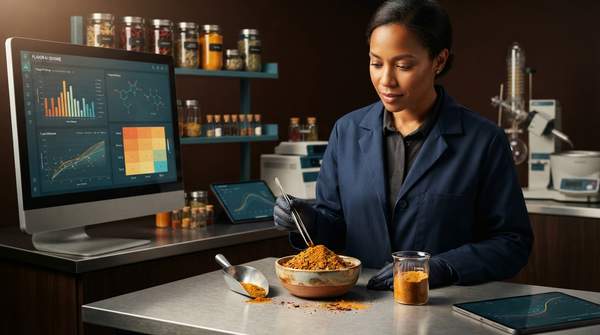
AI develops new food and snack flavors by digesting enormous datasets—existing flavor formulas, raw material compositions, historical recipes, sensory profiles, and consumer feedback—then using machine learning to spot patterns and suggest ingredient combinations that a human formulator might never try. The best-documented proof that this works in the real world is the multiyear collaboration between McCormick & Company's R&D team and IBM Research, which produced the first AI-enabled retail seasoning products under McCormick's "ONE" product family. The process, however, is not a robot chef working alone: it is a pipeline that ends with human product developers making the final call.
The AI-Driven Flavor Development Pipeline
Strip away the science-fiction aura and AI flavor development is a sequential process with four distinct stages: data collection, AI analysis, output generation, and human validation. In the first stage, the system gathers everything relevant to flavor that a company has recorded—previous formulas, ingredient compositions, experimental results, and what consumers have said about past products. In the second, machine learning models sift through millions of these data points to identify patterns, such as which ingredient characteristics tend to co-occur in flavors people love. The third stage turns those patterns into concrete suggestions: new ingredient combinations or optimized formulas matched to a target taste profile. The fourth stage belongs to people—product developers who review, refine, and decide what actually goes to market.
Data Inputs: Fueling Flavor Innovation
The fuel for this engine is data, and lots of it. In the McCormick–IBM system, the AI analyzed extensive historical data including previous flavor formulas, raw material compositions, consumer feedback, and experimental results, as reported by Food Technology Magazine. The variety matters as much as the volume. Sensory data is another critical input: the analytics firm Gastrograph runs its own large-scale global data collection through its sensory system, with teams profiling the perception and preferences of different countries and regions every week, plus standing panels in New York and Shanghai for rapid testing of products and categories of interest. Consumer trend information rounds out the picture, telling the system not just what people liked last year but what they are likely to crave next. Without rich, varied inputs, the AI has nothing meaningful to learn from.
AI Analysis and Output Generation
Once the data is in, the analysis stage is where the magic happens. IBM Research describes a "distance model" at the heart of its system: the AI learns how far apart ingredients are in flavor space. Sometimes the goal is fine-tuning within one ingredient family—finding the best combination of vanilla beans sourced from different parts of the world to deliver a desired experience. Other times the goal is genuine novelty, where the distance between ingredients (vanilla versus strawberry, for example) matters more than the choice within a single family. Because the system is data-driven, its insights evolve as the data changes.
The output is a set of suggested flavor formulas: novel combinations aligned to specific taste profiles that conventional brainstorming might never surface. As Gastrograph's team put it, "AI can develop flavors and flavor combinations no human formulator would have ever thought of."
Human Validation: The Essential Final Step
No AI system ships a product on its own. The final stage of the pipeline belongs to human product developers, who use the AI's insights to make informed decisions more quickly than they could through conventional methods. A paper co-authored by McCormick R&D and IBM Research researchers, published in Cereals & Foods World, frames the technology as computational creativity—a tool to assist human developers in creating new flavor and food products, not replace them. The AI narrows a vast possibility space down to promising candidates; the humans apply judgment about cost, sourcing, safety, brand fit, and whether a suggested combination actually tastes good. This division of labor is the design principle, not a limitation bolted on afterward.
The AI Flavor Development Pipeline: From Data to Dish
The full sequence, from raw records to a shelf-ready seasoning, can be traced stage by stage. Each step has defined inputs and a defined output, and the model below shows how an abstract flavor idea becomes a data-backed, testable formula.
| Stage | What Happens | Key Data Inputs | Outcome |
|---|---|---|---|
| 1. Data Collection | The system gathers diverse flavor-relevant data from company records and sensory programs | Existing flavor formulas, raw material compositions, historical recipes, sensory data, consumer feedback, experimental results | A comprehensive dataset the AI can learn from |
| 2. AI Analysis | Machine learning identifies patterns across millions of data points, using a distance model to measure how ingredients relate | The full collected dataset | Learned patterns and ingredient relationships |
| 3. Output Generation | The system suggests novel ingredient combinations and predicts pairings aligned to target taste profiles | Patterns and distance relationships from stage 2 | Candidate flavor formulas for review |
| 4. Human Validation | Product developers review, refine, and decide which suggestions advance | AI-generated candidates plus expert judgment | A testable, market-ready formula |
Applied to the McCormick–IBM collaboration, the pipeline runs end to end: McCormick partnered with IBM Research in 2019 to integrate AI into product development, aiming to enhance efficiency, accelerate innovation, and explore unique ingredient combinations that conventional methods might not have considered. The collaboration's first publicly available results were three new AI-enabled McCormick products sold in online markets and brick-and-mortar stores—the first AI-enabled retail products under the "ONE" product family. IBM Research noted that the evidence of how pervasive AI tools have become "may be as close as the AI-enabled seasonings in your next meal."
Beyond Snacks: Broad Applications of Flavor AI
The same principles generalize well past the snack aisle. IBM Research states that the underlying technology of its AI for Product Composition initiative can be applied to cosmetics, fragrances, detergents, adhesives, lubricants, and even construction materials—anywhere the challenge is combining ingredients to achieve a target sensory or functional experience. The ongoing McCormick collaboration, IBM adds, will continue to tackle more dimensions of product development and leverage previously untapped data sources. Elsewhere in the food industry, Unilever has used AI to screen thousands of ingredient options and arrive at an optimal formulation for Knorr Zero Salt Stock Cubes, running virtual tests and scenarios to optimize products before the lab and scale-up stage. The examples here are illustrative, not exhaustive—other companies are pursuing similar approaches, and the field is expanding quickly.
Accelerating Innovation with AI
Companies can significantly accelerate flavor innovation and explore unique combinations by integrating AI into their product development process. The measurable indicator of success is the launch of new, AI-assisted retail products and reduced time-to-market for novel flavors—both demonstrated by McCormick's AI-enabled ONE seasonings reaching store shelves. For readers watching this space, the next milestones to track are concrete: new AI-assisted product launches, and the widening of the technique from seasonings into categories like fragrances and cosmetics, where IBM Research says the same ingredient-combination principles already apply.
Sources
- Using AI to develop new flavor experiences — IBM Research
- How AI Is Reshaping Product Development — IFT
- Insights
- Cereals & Grains Association — Cerealsgrains