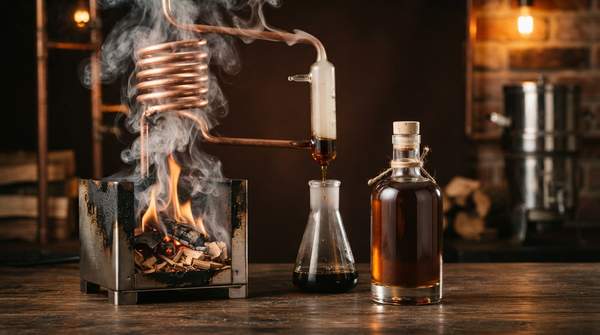
Liquid smoke is made by burning wood under controlled conditions, capturing the resulting smoke, cooling it until it condenses into a liquid, and then filtering that liquid to strip out tar, ash, and other undesirable components. What survives the journey is a water- or oil-soluble concentrate of genuine wood-smoke flavor — a real, plant-derived ingredient rather than a synthetic chemistry experiment. That combination of authenticity and purification is exactly why food manufacturers reach for it when they want smoky notes in clean-label and plant-based snacks, where the ingredient list is under as much scrutiny as the flavor.
The Essence of Smoke: A Controlled Beginning
Everything starts with real wood — typically chips or sawdust — burned in a controlled environment to generate smoke. This is the step that keeps liquid smoke honest as a "natural smoke flavor": the flavor compounds are not synthesized in a lab, they are produced by combustion of the same material a pitmaster would throw on a fire.
The food writer known as Meathead, writing on his barbecue-science site, asked physicist Greg Blonder to describe what is actually inside that smoke. His answer captures why the controlled step matters: "Wood combustion smoke contains hundreds of chemical compounds. A few with sweet pronounced caramel notes, others smoky and clean like an autumn campfire, but many are bitter and acrid. Some are carcinogenic and others antibacterial and others act as a preservative."
In other words, raw smoke is a messy cocktail. Controlled combustion is the manufacturer's first chance to influence that mix, and the later stages exist precisely to sort the desirable from the acrid.
Capturing Flavor: The Condensation Process
Smoke is mostly gas, and gas is a terrible thing to put in a bottle. The second stage solves that problem physically rather than chemically. Manufacturers collect the smoke from the combustion chamber and cool it, and as it cools, the smoke condenses into a raw liquid — the same phase change that turns steam back into water.
This condensation step is the pivotal transformation in the whole process, and it is where the flavor is captured. As Blonder explains, most smoke compounds are gases that "cannot be captured and bottled in liquid form, or rapidly degrade into flavorless molecules." But a subset of smoke compounds — the ones that are water-soluble or oil-soluble, and stable enough to survive — can be "condensed, filtered, and washed out of the smoke and then sold by the bottle."
So condensation acts as a natural selection filter at the molecular level: it preferentially captures the stable, soluble flavor carriers while leaving the fleeting, unstable gases behind. The raw liquid that drips out at this stage already tastes smoky, but it is not yet food-grade or pleasant on its own — which brings us to the third stage.