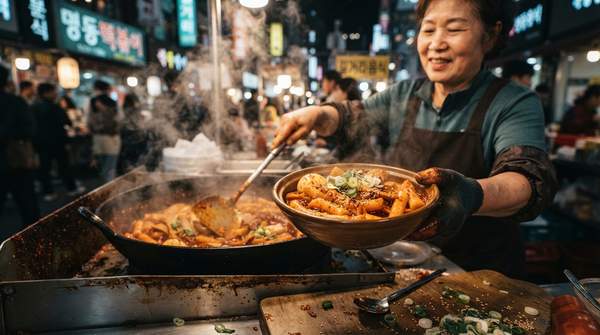
Seoul's most iconic street snack began its life nowhere near a street. Tteokbokki — the chewy rice cakes now swimming in fiery gochujang chili paste at every market stall and snack bar — started as a soy-sauce-based dish enjoyed by the Korean royal family, seasoned with beef and perilla seeds for ceremonial occasions. Its journey from palace delicacy to affordable everyday food mirrors Korea's own turbulent modern history, and it explains why the city's street food scene feels simultaneously ancient and hyper-modern.
The Royal Origins of Tteokbokki: From Court to Commoner
Long before anyone associated tteokbokki with spicy red sauce, the dish was a fixture of the Korean royal court. Culinary records place gungjung tteokbokki — literally "palace tteokbokki" — in the Joseon Dynasty (1392–1897), the period that defined much of Korea's food culture as it is known today. This original version bore little resemblance to the neon-red snack tourists photograph today: it was a savory, non-spicy preparation built on soy sauce, and it belonged firmly to the elite.
The Korean Food Promotion Institute, the official portal for Korean cuisine, confirms that tteokbokki "was also once enjoyed by the royal family," made traditionally with beef and perilla seeds for ceremonial occasions. Spicy versions featuring chili pepper were enjoyed as a delicacy, but the dish's core identity remained aristocratic. It was, the institute notes, a high-class dish served in restaurants until the period of Japanese colonial rule. In other words, for roughly five centuries, tteokbokki was defined by who could afford to eat it and where.
The Spicy Revolution: Tteokbokki's Emergence as a Street Food Staple
The decisive turn came after liberation in 1945. According to the Korean Food Promotion Institute, tteokbokki "became a popular street food after liberation, being sold at Dongnae market." The dish shed its restaurant-only status, moved outdoors, and adopted the gochujang-based sauce that now defines it worldwide. Today the standard serving pairs the rice cakes with eomuk (fish cakes), boiled eggs and scallions, all coated in chili paste — a composition that would have been unrecognizable at the Joseon court.
The transformation reflects broader socio-economic change rather than a single documented event: the shift in the dish's social status and ingredients — from an expensive, ceremonial soy preparation to a cheap, filling street snack — points to the demand for affordable, accessible food in the difficult post-colonial and post-war years. That inference is drawn from the documented change in status and ingredients, not from an explicit cause-and-effect account in the historical record. What the record does show is the result: a former royal dish reborn as food for the masses, sold from market stalls rather than served in restaurants.