What makes food crunchy? The short answer: a combination of physical structure, moisture control, and — surprisingly — your ears. A satisfying crunch is not just a texture; it is a multisensory event in which the sound of the bite travels through your jaw and teeth to your inner ear, shaping how fresh and tasty the food feels. Food industry reporting on the science of snacking shows that sound plays a critical role in the overall consumer experience, affecting perception, satisfaction, and even brand loyalty. And "crispy" and "crunchy," though often used interchangeably, are distinct textures with different structures, sensations, and lifespans in the mouth.
The Science of Snack Satisfaction: Beyond Taste
Taste gets the credit, but texture does much of the work. Ingredient solutions company Ingredion's 2024 Texture Research study found that 79% of consumers agree or are neutral that texture is a determining factor in the overall satisfaction of eating, and that 52% would not eat a food if they didn't like its texture. In other words, a snack can be perfectly seasoned and still fail if the bite feels wrong.
Texture is a structural property. Crispy and crunchy foods owe their character to rigid, dry structures that fracture under the teeth rather than bending or squashing. That rigidity is why moisture is the enemy: water softens the structure, and a once-shattering snack becomes a sad, yielding one. Achieving either texture requires different ingredient systems and processing strategies, according to Ingredion, which points to the role of starches, fibers, proteins, and hydrocolloids in building — and protecting — those structures against sogginess.
Crispy vs. Crunchy: A Comparative Framework
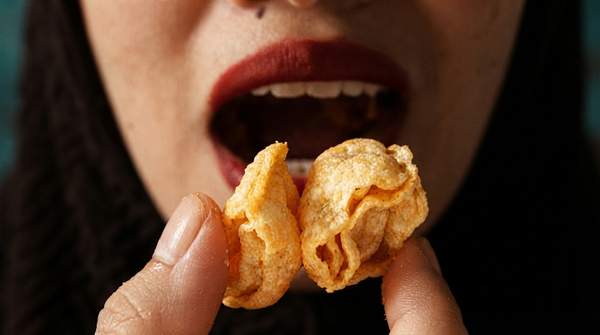
The clearest way to tell the two apart is to count your bites. As food science writer Gill Hyslop reported for BakeryAndSnacks in June 2024, quoting Professor Lee: "The longer you use your teeth, the crunchier a product is considered." A potato chip's crispness typically disappears after four or five bites, while a tortilla chip is still going strong after ten. Crispness is also sensed in two places at once — in the mouth, where nerve endings including those of the teeth register a sharp, sudden, complete break "like the shattering of glass," and in the ear.
Mapping the evidence onto each term produces a framework you can use to classify any snack:
| Dimension | Crispy | Crunchy |
|---|---|---|
| Physical description | Light and brittle, easily fractured (per Ingredion) | Denser and firmer, requiring more force to break (per Ingredion) |
| Duration of sensation | Short-lived — potato chip crispness typically disappears after four or five bites | Longer-lasting — a tortilla chip keeps its crunch past ten bites; crunchy foods are perceived as harder to eat |
| Mouthfeel character | A sharp, sudden, complete break, like the shattering of glass | Sustained chewing resistance that keeps the teeth working |
| Food examples | Potato chips | Tortilla chips |
The classification rule that falls out of this comparison: if the sensation vanishes within a few bites and fractures like glass, it's crispy; if it resists and endures, it's crunchy.
The 'Crunch Effect': How Sound Shapes Flavor
Here is where snacking gets genuinely strange: you hear your crunch from the inside. Hyslop's reporting describes a science that involves how the jaw, teeth, and soft tissues of the mouth influence perceived sounds — specifically bone-conducted sound travelling through the teeth and jaws to the ear. Alongside air conduction, the number of sound bursts in a bite, and the frequency and pressure level of those bursts, this internal soundtrack is part of how your brain evaluates every mouthful.
This is the "Crunch Effect": the sound made during snack consumption can impact its overall acceptability. Research on crunch perception indicates that a louder crunch is associated with higher ratings of freshness and taste, while a muted crunch can make identical food seem stale. The sound is not a byproduct of eating — it is an integral part of the multisensory experience linked to overall pleasure and satisfaction. That is why the sound of snacking is treated as a key element in product development, marketing, and sensory evaluation.
The Psychology of Crunch: Why We Crave It
Why does a sharp crackle feel so good? Sensory psychology writing on crunchy food suggests our brains respond positively to the sharp, clean sound of crunching, which can trigger pleasure centers — the brain receives signals suggesting the food is fresh and ready to eat.
There may be deep history behind this response. From an evolutionary perspective, crunch served as a survival mechanism: our ancestors relied on texture as a crucial indicator of food safety, with crisp, crunchy fruits and vegetables typically signaling freshness and edibility, while soft, mushy textures could indicate spoilage. That deep-rooted connection between crunch and freshness still shapes how we judge food today — which helps explain why a stale-sounding chip disappoints us even before we consciously register its flavor.
Engineering the Perfect Bite
Put the three layers together and the "perfect crunch" stops being a mystery. The structure layer: a dry, rigid matrix — light and brittle for crispness, dense and firm for crunch — built through ingredient and processing choices. The auditory layer: the fracture of that structure generates sound bursts conducted through air and bone to the ear, feeding the brain's freshness assessment. The psychological layer: a clean, loud crunch triggers a positive response rooted in texture's ancient role as a safety signal.
This is also why texture is a commercial battleground. Ingredion's research on consumer preference — 79% saying texture influences satisfaction, 52% rejecting foods with poor texture — explains why snack developers obsess over coating systems and moisture barriers. A snack that loses its crunch loses its customer, and the failure announces itself audibly.
Enhancing Enjoyment Through Sensory Awareness
To fully appreciate snack foods, pay attention to the multi-sensory experience, particularly the sound of the crunch, as it significantly influences perceived freshness and taste. The evidence supports a simple test: a noticeable difference in perceived freshness and taste when comparing a loud, clear crunch to a muted one in the same type of snack. Try it yourself — bite into a fresh chip, then a softened one, and notice how your judgment of its flavor changes with the volume. Once you hear your snacks as clearly as you taste them, you'll understand exactly what food scientists mean when they say crunch is engineered, not accidental.